Torah: (Bereishit) Genesis 12:1 – 17:27; Haftarah: (Yeshayahu) Isaiah 40:27 — 41:16
SEPARATE FROM SIN
Parashah Noach ends with the men’s desire to live independently of God’s ethics by thumbing their noses at Him in building a tower designed to reach the sky with the intent to “make a name for themselves.” God stops their project by confusing their language and disperses them throughout the earth giving rise to the seventy nations. But there was one family that it was singled out to continue Noach’s legacy, the family of Terah with his son Avram.
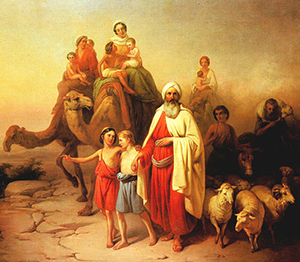
This new Parashah begins with the LORD telling Avram ”Lech Lecha me’aretzecha, get yourself out of your native land” to a new land. Avram’s verbal response is not recorded but his response is action in obedience. “Speak little but do much” was the conclusion of the rabbis in the Pirkei Avot.
After the introduction of sin by Adam, sin dominated the life of men. Murder had been introduced by Cain, idolatry, perversion, and disobedience became the norm throughout the world; ten generations had been washed away by the Flood, and the ten generations from Noah to Avraham had fallen also into sin. But with Avraham began a profound change in the spiritual nature of mankind. God asked Avraham to separate himself from sin and his actions become an example to humanity of what it means to live a righteous life.
God revealed Avraham’s character by subjecting him to some tests of faith. A heavenly test is one that forces a person to choose between God's will and his own understanding of what is right or wrong. These trials were meant to display faithful obedience, but God does not impose trials that are beyond the capacity of the individual. Thus, all Torah's trials are for the benefit of those being tested, even though the benefit may not be realized for a long time.
Believers must understand that following God is an unpopular lifestyle, but the choices we make when we are being tested strengthen our faith because faith without works is useless and our faith is measured by our good actions not by our good intentions (please read James chapter 2). In the same time we have to understand that God will never test us beyond our abilities to endure as written in 1 Corinthians 10:13: "No temptation has overtaken you, except that which is common to Bnei Adam, but, the LORD is faithful, who will not let you to be brought into temptation beyond what you are able, but will make with the temptation also the escape as a way out for you to be able to endure. Therefore, my beloved, flee from idolatry."
Yeshua did not ask us to separate from this world (John 17:15) but to separate from sin, to flee from it, and be light and salt to the unbelieving world but not part of it. Just as Avraham was asked, as a first step, to get himself out from an idolatrous country, so too we are asked to separate from sin.
Abraham was called an "Ivri," from the word which means "from the other side." Literally this means that he came to Canaan from the other side of the Euphrates, but in a spiritual sense he crossed a moral and spiritual divide and came into the Promised Land which would become not only the heritage of his family, Eretz Yisrael, but also of all believers. In the spiritual sense we become the sons of Avraham if we do the deeds of Avraham which begin with obedience to God. We will be blessed if we follow Avraham's example, and, if we push God aside, our life will be like a curse.
In this Parashah God gives Avraham the covenant of circumcision, and He calls it My covenant. But in other verses circumcision is also called "the sign of the covenant," implying that a commandment consists of two parts: one, the physical act and two, its underlying moral or spiritual teaching — and neither is complete without the other. Just as it is not enough to perform the commanded deeds if they are removed of their moral content, so it is not enough to philosophize on the commandments and seek moral improvement without actually performing the commandment.
"And in you all the families of the earth shall be blessed" (Genesis 12:3). This is the great promise fulfilled in Avraham's Seed, Messiah Yeshua, and in all the spiritual seeds of Avraham who, like Avraham, are justified by faith. It gives added revelation and confirmation of the promise of the Adamic Covenant - concerning the Seed of the woman (Genesis 3:15). The Avrahamic Covenant reveals the sovereign purpose of God to fulfill through Avraham His program for Israel, and to provide in Messiah the Savior for all who believe. The ultimate fulfillment is made to rest upon the divine promise and the power of God rather than upon human faithfulness. God did His part, He sent His Son to die for our sins on that Roman execution stake to fulfill all requirements for cleansing of sin.
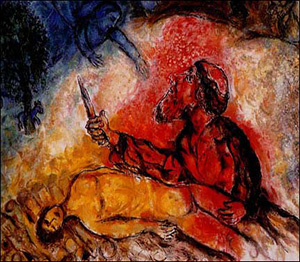
God loved us so much that He gave His one and only Son to die - that we might live. The love of God is beautiful, gracious, holy and merciful. A love that went to such terrible and heartbreaking depths to redeem us from our sins must cause an appropriate response from our hearts. Yeshua said, “If you are Avraham's children, do the deeds of Avraham," John 8:39. The principle of faith without works being useless is at work here, for Avraham who had the faith to offer up Isaac, his son, on the altar, began by doing small deeds, by giving to God in the form of the tithe.
In chapter 14 we see an example of that when Avraham was met by a very unusual person named Melchizedek. Melchizedek is called King of Salem and a priest of God Most High, which is a typology of Messiah, as revealed in Psalms 110 through David where God the Father speaks with God the Son, Yeshua: "The Lord says to my Lord, “Sit at My right hand, until I make Your enemies Your footstool. The Lord sends Your mighty scepter from Zion. Rule in the midst of Your enemies! Your people offer themselves willingly on the day of Your battle, in the majesty of holiness, from the womb of the morning, when the dew of Your youth was upon You. The Lord has sworn, and will not change His mind, You are a priest forever, after the manner of Melchizedek.”" Avraham gave this Melchizedek a tenth of all his possessions because in his heart was love for God and thanksgiving. By these simple acts his faith was being strengthened so in the end he could trust God and offer up Isaac.
Rav Shaul, the apostle Paul, teaches that faith works through love. If we love Yeshua, then our faith will perform its work, and that is the reason God has taught us to tithe continually. Our faith must be tested. The Hebrew word for giving is “tzedakah,” but this word also means “righteousness,” which implies that our righteousness is tested in our giving. Avraham deeds were reckoned to him as righteousness because by his deeds his faith was perfected (James 2:22,23). His faith was working. His trust was in God and because of this trust his heart was responding to His love.
In Chapter 17 of this Parashah, verse 1, for the first time God introduces Himself as El Shaddai — literally "He Who is Sufficient," He Who has sufficient power to give us whatever is necessary to overcome all opposition and live a righteous life. Avraham made a conscious decision to distance himself from sin because he trusted El Shaddai, the God who is all sufficient. Let us also do the deeds of Avraham.
Shabbat joy, peace, and blessings! Shabbat Shalom!