Torah: Shemot (Exodus) 35:1 – 38:20; Haftarah Shabbat Parah Adumah: Ezekiel 36:16-38
Shabbat Parah Adumah
Purification from sins
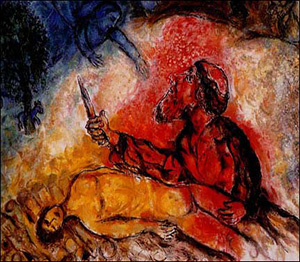
On the Shabbat after Purim, two Torah Scrolls are removed from the Ark. The Sidrah of the week is read from the first, and from the second, the Maftir, the additional reading from Bamidbar about the Parah Adumah, the Red Heifer. The reading from this chapter was instituted for this time of the year because worshipers were required to purify themselves coming to Jerusalem for the pilgrimage festival of Passover.
"This is the decree of the Torah which The LORD has commanded, saying, ‘Speak to the sons of Israel that they bring you an unblemished red heifer in which is no defect, and on which a yoke has never been placed. And you shall give it to Eleazar the priest, and it shall be brought outside the camp and be slaughtered in his presence. Next, Eleazar the priest shall take some of its blood with his finger, and sprinkle some of its blood toward the front of the tent of meeting seven times. Then the heifer shall be burned in his sight... Now a man who is clean shall gather up the ashes of the heifer and deposit them outside the camp in a clean place, and the congregation of the sons of Israel shall keep it as water to remove impurity; it is a purification from sin.’" Bamidbar (Numbers) 19:2-9
This passage is about the purification from sin for the entire nation of Israel, not as a community - that was the scapegoat, the Azazel, of Yom Kippur - but as individuals as they were coming to the Temple. The ritual was performed continuously until the destruction of the Temple in Jerusalem in 70 AD. Therefore, the nation of Israel has not performed this Mosaic ritual for almost 2000 years. Were the Jews not able to remove impurity from sin in this period of time? Was God’s commandment annulled? Or was there an event that fulfilled all God’s requirements for the purification from sin?
Indeed, all these sacrifices that the Torah speaks about are images of Yeshua’s substitutionary sacrifice. His sacrifice fulfilled their meaning and replaced them all, and not only it is all sufficient to remove the impurity from sin, but it is the only sacrifice that can remove the guilt of sin once and for all. With the advent of Moshiach the Mosaic system of sacrifice was over, we have been purified by His shed blood instead that of the bulls, thus, the validity of God’s commandment given in the Torah remains - man's purification from sin can be done only by a blood sacrifice.
The Haftarah from the prophet Ezekiel written 500 years before the destruction of the Temple gives us an amazing insight of how people behaved, why, and who dispersed them throughout the nations. Unfortunately, their behavior among the nations did not change, but God in His infinite love for them and for the sake of the faithful forefathers, will gather them back into their land and restore His fellowship with them.
“Son of man, ben adam, when the house of Yisrael lived in their own land, they defiled it by their way and by their doings: their way before Me was as the uncleanness of a woman in her impurity. Therefore, I poured out My wrath on them for the blood which they had poured out on the land, and because they had defiled it with their idols; and I scattered them among the nations: according to their way and according to their doings I judged them. When they came to the nations, where they went, they profaned My holy Name; in that men said of them, ‘These are the people of the LORD, and are gone forth out of His land.’ But I had regard for My holy Name, which the house of Yisrael had profaned among the nations. For I will take you from among the nations, and gather you out of all the countries, and will bring you into your own land. I will sprinkle clean water on you, and you shall be clean: from all your filthiness, and from all your idols, I will cleanse you. A new heart also I will give you, and a new spirit I will put within you; and I will take away the stony heart, and I will give you a heart of flesh. I will put My Spirit within you, and cause you to walk in My statutes, and you shall keep My ordinances, and do them. You shall dwell in the land that I gave to your fathers; and you shall be My people, and I will be your God.” Ezekiel 36:17-27
This future restoration is symbolized by the two High Holydays, Yom Teruah and Yom Kippur, may it happen in our lifetime.
"YESHUA — OUR SHABBAT"
This week’s Parashah is as much about the construction of the Mishkan, as about the people’s response when they were asked to give for its construction. It presents a stark contrast between a passage talking about people's heart, and a passage talking about Pharaoh’s heart. One is talking about a willing, wise, and generous heart toward the things of God, the other is about a hardened heart. But the Parashah starts with the commandment to observe the Shabbat: “And Moshe gathered the entire assembly of the people of Yisrael together, and said to them, ‘These are the things which the LORD has commanded, that you should do them. On six days work shall be done, but the seventh day shall be holy for you, a day of Shabbat for the LORD; whoever does work on it shall be put to death.’ ” (Shemot 35:1-2)
From the fact that the commandment to observe the Shabbat precedes the building of the Mishkan, the sages concluded that labor is of value only if it can have a sacred as well as a secular purpose; otherwise, it is innately trivial - all our labor for the earthly things is just vanity and striving after wind. “The words of Kohelet Ben David, the son of David, king in Yerushalayim. ‘Vanity of vanities,’ said Kohelet, ‘vanity of vanities; all is vanity. What gains a man from all his labor at which he labors under the sun?’ “ (Ecclesiastes 1:1-3) The wisest man that ever lived, King Solomon, is searching for a meaning in the man’s toil on the earth, and, in the end, he finds the answer: “Fear God, and keep His commandments; for this is the whole duty of man. For God shall bring every deed into judgment, with every secret thing, whether it is good, or whether it is evil.” (Ecclesiastes 12:13)
The man who could have had anything under the sun concluded that anything of value that man can do is obeying God’s commandments, everything else is vanity and striving after the wind which can be taken away in a blinking of an eye. But this order of commandments - observing the Shabbat before building the Mishkan - also signifies that an outwardly acknowledgment of God must precede any service to Him. It parallels the giving of the ten commandments, as they too, in order to have any meaningful observance must be preceded by the acknowledgement of who is the author of them. "I am the LORD your God who brought you out of the land of Mitzrayim, out of the house of bondage.” (Exodus 20:2) Our service, as believers, is also of no value if we do not acknowledge God first, and acknowledge that Yeshua haMoshiah is Lord, “every tongue shall confess that Yeshua haMoshiah is Lord, to the glory of God the Father.” (Philippians 2:11)
By observing the Shabbat we acknowledge that God is the Creator of the universe and that the creation of the world would not be complete without a day of service to Him. Our Shabbat service should be a paraphrase of His sanctification of the seventh day. “The meaning of the Shabbat is to celebrate time rather than space. Six days a week we live under the tyranny of things of space; on the Shabbat we try to become attuned to holiness in time... Six days a week we wrestle with the world, wringing profit from the earth; on Shabbat we especially care for the seed of eternity planted in the soul. The world has our hands, but our soul belongs to Someone Else,” writes Abraham Joshua Heschel in his book "The Sabbath."
The fact that the commandment to observe the Shabbat precedes the building of the Mishkan tells us that the primary productive labors in the material world are precisely those that are needed to create an abode for sanctity. This abode is actually not the physical Mishkan, which can become an empty shell, devoid of its inner holiness and can be even destroyed - as it already happened, but the Shabbat. Shabbat is a spiritual institution. “The Shabbat is our great cathedrals and our Holy of Holies, is a shrine that neither the Romans nor the Germans were able to burn,” continues Heschel. The observance of the Shabbat is a prerequisite to the worship in the Mishkan and thus, the worship in any other sanctuary made by human hands.
But Yeshua said: “I am the Lord of the Shabbat.” Thus, for us the believers, the Shabbat has a greater meaning. Celebrating the Shabbat is worshiping Yeshua for which we do not need any special sanctuary but the sanctuary of the body of believers, the fellowship with one another. Shabbat is a day for gathering together for praising and giving thanks to Yeshua.
The implied holiness of the Shabbat may have been the reason for the tremendous and the generous people’s response in bringing a portion for the LORD.
Shemot 35:4: “And Moshe spoke to all the congregation of the people of Yisrael, saying, ‘This is the word which the LORD commanded, saying:
35:5: 'Take from among you a portion for the LORD; whoever is of a willing heart, let him bring it as a gift to the LORD: gold, silver, and bronze, and blue, and purple, and scarlet, and fine linen, and goats’ hair, and rams’ skins dyed red, and goats’ skins, and shittim wood, and oil for the light, and spices for anointing oil, and for the sweet incense, and onyx stones, and stones to be set for the ephod, and for the breastplate.
35:10: 'Let every man with wise heart among you come and make all that the LORD has commanded.
35:21: ‘Everyone whose heart stirred him and everyone whose spirit moved him came and brought the portion of The LORD for the work of the Tent of Meeting and for all its service and for the holy garments. Both men and women came; all whose hearts moved them, and brought brooches and earrings and signet rings and bracelets, all articles of gold.
35:25: ‘All women with wise heart spun with their hands, and brought what they had spun, in blue and purple and scarlet material and in fine linen. All the women whose heart stirred with a skill spun the goats' hair.
35:29: ‘Every man and woman, whose heart moved them to bring material for all the work, which the LORD had commanded through Moshe to be done, brought a freewill offering to the LORD.”
The construction of the Mishkan was a matter of the heart. God is in no need of our contributions, but our giving is a sincere inner desire to elevate ourselves to a higher spiritual level, to have a part in the things which matter for eternity. Israelis’ hearts were moved not only to bring a portion from the things that the Egyptians gave them as gifts but also a free-will offering from their own labor. Every one of them did not want to be left out from participating in the making a place where the Presence of the LORD can dwell among them. Their response was overwhelming:
“And all the wise men, that did the work of the sanctuary, came every man from his work which they made. And they spoke to Moshe, saying, ‘The people bring much more than enough for the service of the work’... And Moshe gave commandment, and they caused it to be proclaimed throughout the camp, saying, ‘Let neither man nor woman do any more work for the offering of the sanctuary.’ So the people were restrained from bringing. For the stuff they had was sufficient for all the work to make it, and there was extra.” Shemot 36:4-7
The people had to be restrained from bringing gifts for building God’s sanctuary, and if that was their response for a glorious building that was to eventually fade away, how are we to respond for the building of a much more glorious Mishkan, the Temple of the body of believers in which dwells the eternal Glory, Immanuel - God is with us - Yeshua haMoshiah. If you confess that Yeshua haMoshiah is Lord, don't you also want to have a part in the things that matter for eternity by contributing from the fruits of your labor for the building of the eternal Mishkan?
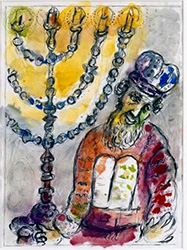
The Parashah ends the account of the Mishkan’s construction with the vessels that represent the essence of the Sanctuary’s teaching. These vessels symbolize the innermost of human ideals. There is an Ark containing God’s teaching; there is a Table that reflects man’s struggle to sustain his physical being by fighting for his daily bread; and finally, there is a Menorah that reflects man’s obligation to spread the light of Torah beyond himself. The Ark that is in the Holy of Holies radiates its holiness to the Table and to Menorah, and through them – and through us – to the entire world.
Shabbat joy, peace, and blessings! Shabbat Shalom!